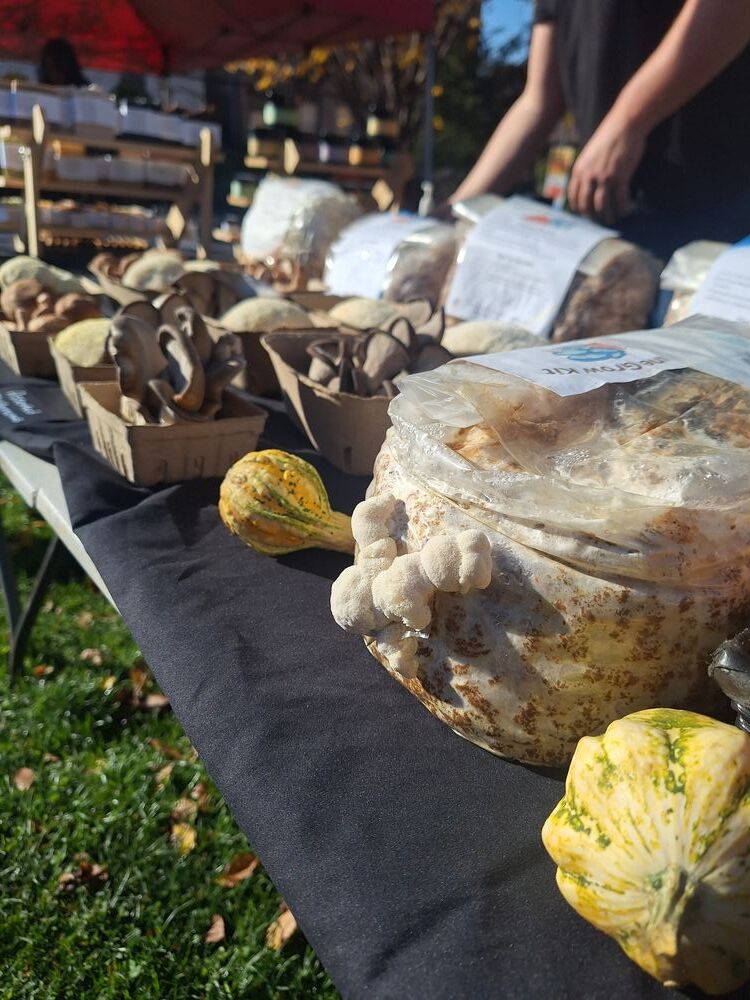
Our first farmers market was a folding table, a hand-painted sign, and about twelve bags of oyster mushrooms. We sold out in two hours and drove home buzzing. That was 2021. Since then, we’ve set up at markets across the Hudson Valley more times than we can count, and the lessons we’ve picked up along the way have shaped everything about how we run Farm Lane Farms.
If you’re thinking about selling at farmers markets — or you’re just curious what it’s actually like behind the table — here’s what we’ve learned.
The Market Is Where You Learn What People Actually Want
When we started, we assumed people would come to our table for mushrooms and that would be the whole conversation. We were wrong. The market taught us that people come for the story first and the product second.
Fresh gourmet mushrooms and grow kits — the market staples.
Almost every customer who stops at our table asks some version of the same question: “So what do you guys do?” They want to hear about the farm, how we got started, why we grow what we grow. The mushrooms get them to stop walking. The conversation is what makes them come back the next week.
That’s also how our product line expanded. Customers told us what they wanted. People asked if we had grow kits they could take home. So we made grow kits. People asked about the tallow products Justyn had been experimenting with at home. So we brought those to market. People asked about liquid cultures for home growing. So we added those too.
Every product we sell today started as a conversation at a farmers market table. Not a business plan. Not market research. A person saying “I’d buy that” and us going home and figuring out how to make it happen.
What We Bring to Market
A typical market setup for us includes:
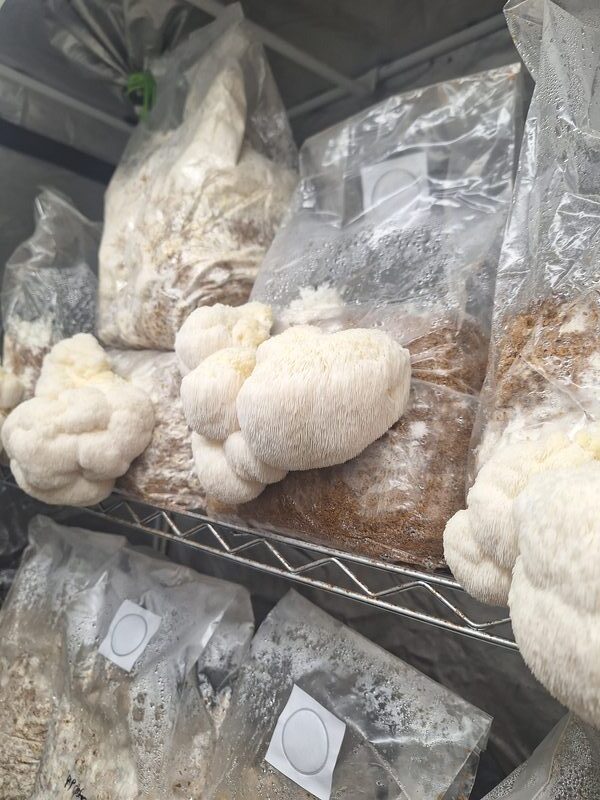
Fresh gourmet mushrooms — Whatever’s fruiting that week. Blue oyster, pink oyster, golden oyster, lion’s mane, king trumpet. We harvest the morning of the market or the night before. Freshness is the whole point.
Grow-at-home kits — Ready-to-fruit blocks that customers can take home and harvest themselves in about two weeks. These are our best conversation starters. People love the idea of growing food on their kitchen counter.
Liquid culture syringes — For the more experienced growers who want to inoculate their own substrate. Smaller market but very loyal customers.
Tallow skincare — Our handcrafted line of body care products made from locally sourced grass-fed beef tallow. Whipped body whips, balms, and bars in various scents. This side of the table draws a completely different crowd than the mushrooms, and that’s been great for us.
Seasonal produce — When our satellite garden at Nusra Farms in LaGrange is producing, we bring tomatoes, peppers, greens, and squash. All grown with regenerative techniques like crop rotation and companion planting.
The Reality of Market Days
Here’s what people don’t see: a farmers market day starts long before setup and ends long after breakdown.
A typical Saturday looks like this:
Thursday–Friday: Harvest mushrooms. Pack product. Check inventory. Print labels if needed. Load the car. This alone is several hours of work.
Saturday 6:00 AM: Arrive at the market site. Unload. Set up the tent, tables, signage, product displays. Everything needs to look good — presentation matters more than you’d think at a farmers market. We’ve learned that a well-organized table with clear signage sells significantly more than the same products thrown on a table.
Saturday 8:00 AM – 2:00 PM: Six hours on your feet, talking to every person who walks by. Answering questions. Making change. Restocking. Keeping the table looking full. It’s genuinely fun, but it’s also physically demanding in a way that surprised us at first.
Saturday 2:30 PM: Break down. Load the car. Drive home. Unpack. Put away anything that didn’t sell. Clean up. Collapse on the couch.
And then Sunday, you might do it all over again at a different market.
We’re not complaining — we chose this and we love it. But it’s important to be honest about the time commitment. A “six-hour market” is really a two-day affair when you account for prep and recovery.
What Actually Sells (And What Doesn’t)
After a year of tracking what moves and what sits, here are some patterns:
Oyster mushrooms are the gateway. Blue oysters especially. They’re familiar enough that people aren’t intimidated, but different enough from grocery store button mushrooms that they feel special. Once someone buys blue oysters and cooks them at home, they come back for lion’s mane and king trumpet.
Grow kits sell on impulse. People who weren’t planning to buy anything see a grow kit, hear the pitch (“you’ll have fresh mushrooms in two weeks”), and grab one. They make great gifts too — we sell a lot of kits around the holidays.
Repeat customers are everything. A person who buys mushrooms from you every week for a season is worth more than fifty one-time buyers. We remember names. We remember what people cooked last week. That’s not a business strategy — it’s just what happens when you genuinely care about what you’re growing.
Weather matters, but not how you’d think. Our best market days aren’t the beautiful sunny Saturdays — those draw crowds, but the crowds are browsing, not buying. Our best sales days are the cool, slightly overcast mornings when the people who show up are the ones who actually came to shop.
Building a Brand at a Folding Table
When you’re a small farm, your brand is you. It’s the way you talk about your product, the care you put into your display, and whether people feel good after talking to you.
Some things we’ve learned about building trust at the market:
Be honest about what you don’t know. Someone asks a mushroom question we can’t answer? We say so, and we find out for them by next week. That builds more trust than pretending to be experts on everything.
Let people taste things. We keep samples of dried mushrooms and testers of our tallow products at the table whenever possible. The number of sales that start with “can I smell that?” or “can I try a piece?” is enormous.
Tell the real story. People can tell when you’re giving a rehearsed pitch versus talking about something you actually care about. Our story — the anniversary mushroom kit, the COVID foraging licenses, the accidental tallow experiment — resonates because it’s real.
Show up consistently. The fastest way to build a market following is to be at the same market every single week. People need to know you’ll be there. Skip a week and you lose momentum that takes three weeks to rebuild.
What’s Next for Us
We’re heading into our fourth full market season, and every year we learn something that makes the next one better. This year we’re expanding our mushroom varieties, increasing our seasonal produce output through our partnership with Nusra Farms, and working on some new tallow products that we’re excited to bring to the table.
If you’re in the Hudson Valley, come find us at a market this season. We’re always at Hyde Park and we rotate through several others in the area. Check our social media for the current schedule.
And if you’re thinking about starting your own small farm or market business — do it. Start small. Start with a folding table and twelve bags of mushrooms. The market will teach you everything else.